
Unmet Physician Needs for New Drugs
15-Year Trend (2011-2025)
Contents
- Introduction
- Analysis overview
- Analysis Result 1: Overall Trends
- Analysis Result 2: Diseases with Marked Declines in Need for New Drugs (Suggesting Fulfillment of Unmet Needs)
- Analysis Result 3: Diseases with Marked Increases in Need for New Drugs (Suggesting the Presence of Unmet Needs)
- Analysis Result 4: Trends by Disease Area: Oncology
- Conclusion
Introduction
In pharmaceutical development, understanding unmet medical needs is critically important. However, these needs are not static—they are constantly evolving. While groundbreaking new drugs may address existing needs, societal changes and shifts in patient values can give rise to new ones.In this case study, to better understand the evolution of unmet needs, we analyze trends over the 15‑year period from 2011 to 2025 in the percentage of physicians expressing a desire for new drugs (hereafter "need for new drugs")
Analysis overview
- Objective:
- To analyze, over a 15-year time frame, how physicians' (unmet) need for new drugs has changed.
- Analysis Data:
- The analysis utilizes 15 years of data (2011–2025) from the physician survey database PatientsMap, specifically the percentage of physicians who desire new drugs for each disease.
- Methodology:
- To avoid being influenced by short-term, single-year fluctuations and to accurately capture mid- to long-term market trends, a four-year moving average was applied. The average value for 2011–2014 was indexed to 100, and subsequent increases or decreases in need were visualized as a change index.
Analysis Result 1: Overall Trends
First, we provide an overview of the average trend over the past 15 years in the need for new drugs across the 127 diseases included in the analysis.
Below is a graph showing the changes in the index at each time point, with the average need for new drugs for 2011–2014 set at 100.
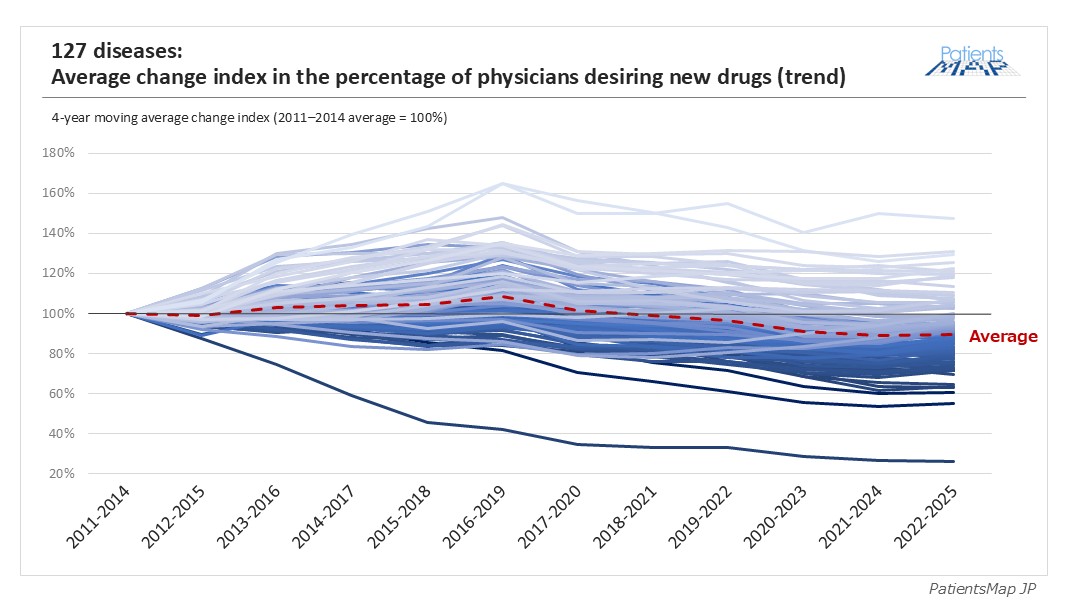
The graph shows that the overall need for new drugs across the 127 diseases has exhibited a gradual downward trend over the past 15 years. This suggests that treatment advances in many disease areas have, to some extent, fulfilled physicians' need for new drugs.
However, focusing solely on this overall average risks overlooking fundamental shifts occurring in the market. In reality, beneath this average are disease areas where needs have been rapidly met, as well as others where unmet needs have instead become more pronounced.
In the next section, we examine these contrasting patterns in greater detail.
Analysis Result 2:
Diseases with Marked Declines in Need for New Drugs
(Suggesting Fulfillment of Unmet Needs)
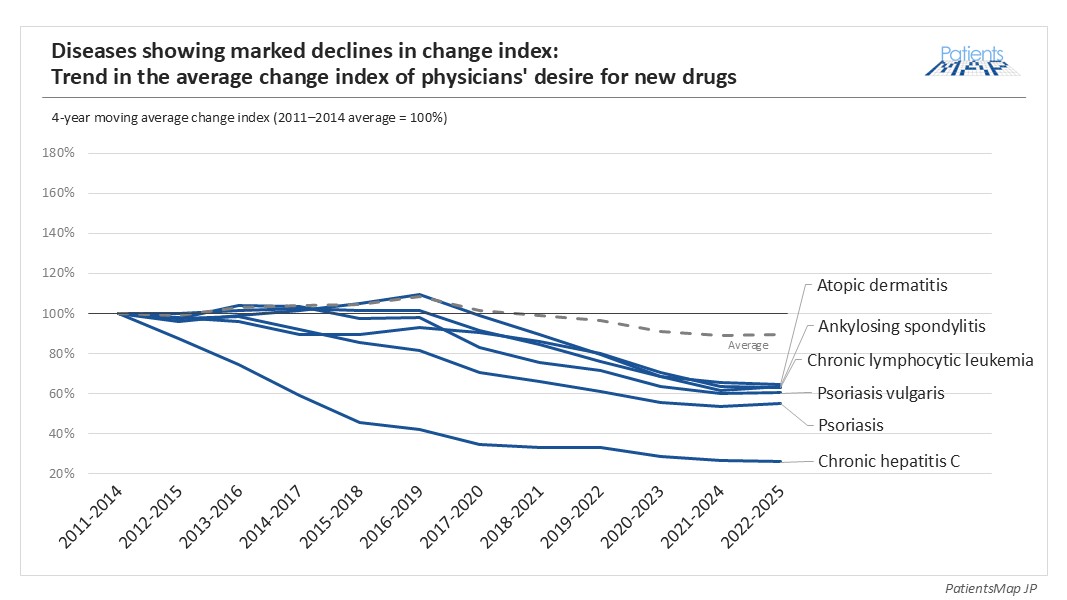
Next, we focus on the group of diseases in which need for new drugs has significantly decreased (i.e., been fulfilled) over the past 15 years.
Below is a graph highlighting disease trends that showed particularly large declines in need.
Discussion:
Chronic hepatitis C stood out as the clearest example of the need for new drugs being met. With the advent of direct‑acting antivirals (DAAs) in 2014, achieving a cure (viral eradication) became a realistic goal, suggesting that physicians' needs were substantially fulfilled.
Similarly, diseases such as psoriasis, atopic dermatitis, and chronic lymphocytic leukemia showed a trend toward fulfillment of the need for new drugs. In psoriasis and atopic dermatitis, the successive introduction of innovative therapies such as biologics and JAK inhibitors has enabled better disease control, which is presumed to have led to a substantial decline in need.
Analysis Result 3:
Diseases with Marked Increases in Need for New Drugs
(Suggesting the Presence of Unmet Needs)
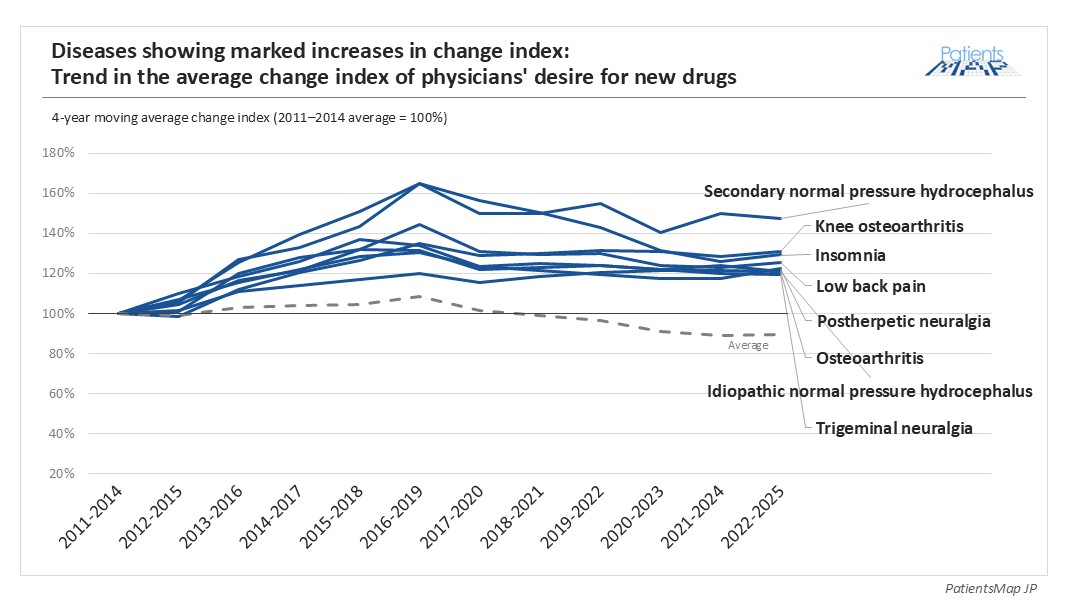
In contrast, there are disease groups whose needs for new drugs have remained flat or even increased compared to 15 years ago.
Below is a graph highlighting disease trends that showed particularly large increases in need.
Discussion:
The most pronounced increase in the need for new drugs was observed in secondary normal pressure hydrocephalus.
In addition, conditions such as knee osteoarthritis, insomnia, and low back pain—conditions that generally pose a relatively low direct risk to life expectancy but significantly impair patients' quality of life (QOL) over the long term—also showed an increase in the need for new drugs. In these areas, strong expectations persist for curative therapies and for safer, more effective treatment options, a trend that has become increasingly evident with population aging.
Analysis Result 4: Trends by Disease Area: Oncology
Lastly, we turn our focus to oncology, a major market segment.
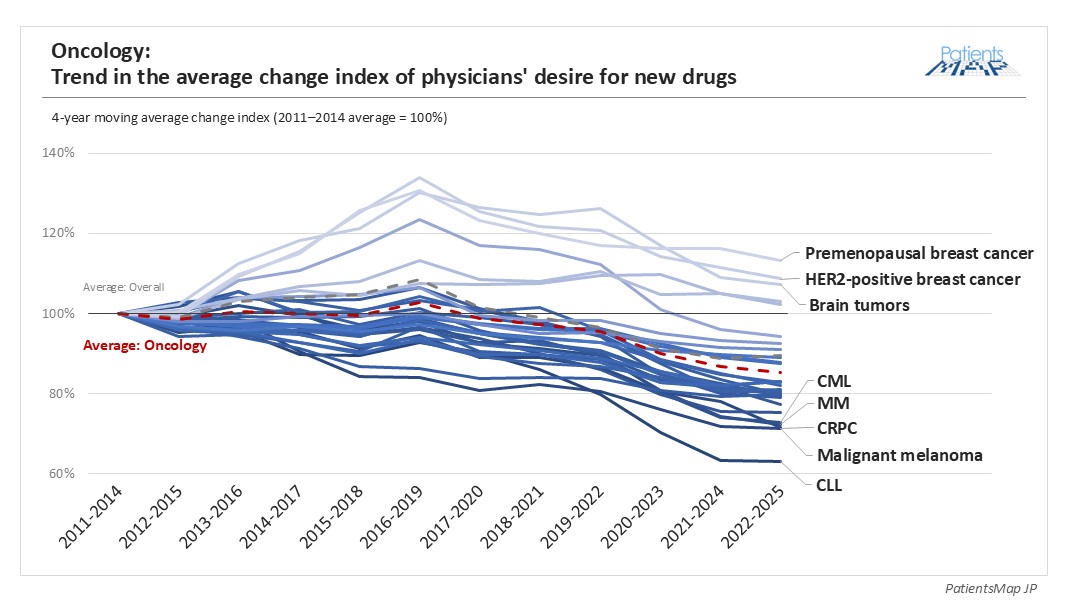
Below is a graph highlighting disease trends in the oncology area.
Discussion:
The average change index for the need for new drugs in oncology also shows a gradual downward trend, similar to the overall trend.
A closer look reveals that in hematologic cancers and certain solid tumors—such as chronic lymphocytic leukemia (CLL), malignant melanoma, endocrine therapy–resistant prostate cancer, multiple myeloma (MM), and chronic myeloid leukemia (CML)—therapeutic advances have been remarkable, suggesting that physicians' needs have been rapidly fulfilled.
Meanwhile, diseases such as breast cancer and brain tumors show a flat or slightly increasing change index. These findings imply that even as cancer treatments continue to advance, new issues are emerging and expectations for the next generation of treatment options are rising.
Conclusion
This case study analyzed the evolution of physicians' need for new drugs over a 15‑year period. The data clearly reveal a structural shift in this need accompanying the remarkable advances achieved in the development of new drugs.- Areas where needs have been fulfilled:
- Diseases such as chronic hepatitis C, along with some cancers and skin conditions, have seen significant fulfillment of needs due to the advent of innovative new drugs.
- Areas where needs have increased:
- Rising needs are highlighted in QOL‑related disease groups such as knee osteoarthritis, low back pain, and insomnia.
This strongly suggests that expectations in clinical practice are shifting beyond the traditional goals of life‑saving and life‑prolonging treatment toward the maintenance and improvement of QOL. In future drug development, addressing unmet needs in these QOL‑related areas is expected to become increasingly important.
Using PatientsMap for time‑series analysis of unmet medical needs enables long‑term evaluation of trends across many diseases, including rare diseases, and visualizes shifts in unmet needs that were previously difficult to capture. This facilitates data‑driven decision‑making and contributes to significantly increasing the probability of success in new drug development.
Consider integrating PatientsMap insights into your product development and marketing strategies.
We can also provide more detailed analyses and tailored proposals to address your company's specific needs.
Related articles
Exploring Unmet Needs by Listening to Physicians’ Real Voices - What are the UMNs in cancer treatment? -