
Is the "Return to Face-to-Face" Really Happening?
Market Blind Spots and Next-Generation Channel Strategies
Contents
- Introduction
- Analysis overview
- Analysis Result 1: Overall Trend: The Resurgence of "In‑Person" and the Entrenchment of Digital Content
- Analysis Result 2: Facility size: Accelerating polarization of needs between HPs and GPs
- Analysis Result 3: By Years of Experience: Early‑Career Physicians Value In‑Person Interaction
- Conclusion
Introduction
As society moves beyond the COVID‑19 pandemic and returns to normalcy, the flow of information in clinical settings is once again at a major turning point.
Following an accelerated digital shift, a countertrend has emerged—the resurgence of in‑person engagement.
As digital transformation takes root and in‑person engagement is reassessed, many pharmaceutical companies are confronted with a critical management question: "Ultimately, to which channels should we allocate our limited resources?"
In this analysis, we examine three years of data from PatientsMap, with responses from over 20,000 physicians, to visualize changes in the information sources physicians consider important. Using these data‑driven insights, we explore implications for effective channel strategies in pharmaceutical marketing going forward.
Analysis overview
- Objective:
- To identify changes over the past three years in the information channels physicians consider important and to derive insights for next‑generation channel strategies.
- Analysis Data:
- Physician survey database PatientsMap (2023–2025)
- Methodology:
- Analysis of year‑over‑year trends in physicians' responses to "information sources you consider important (select up to three)."
Analysis Result 1: Overall Trend:
The Resurgence of "In‑Person" and the Entrenchment of Digital Content
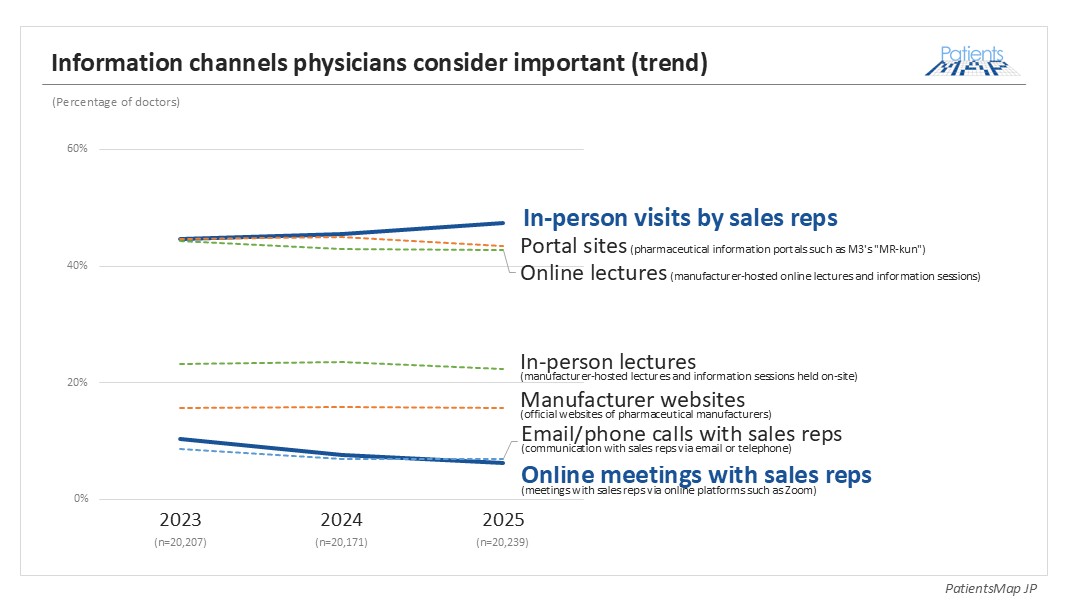
First, we review overall trends in the importance physicians place on different information channels.
Discussion:
The data point to a clear selection of channels by physicians. While online meetings with sales reps, which spread rapidly during the pandemic, have begun to decline, traditional in‑person sales rep visits are on the rise, indicating a renewed appreciation for face‑to‑face communication.
At the same time, trends in lectures are particularly noteworthy. Despite the recovery in in‑person sales rep visits, there has been no comparable return to in‑person lectures, while online lectures remain at a consistently high level. Three factors likely underlie this pattern:
Homogenization of information:
For academic information, physicians increasingly see little difference between in‑person and online formats.
Changes in communication:
The priority once placed on face‑to‑face networking among physicians at in‑person lectures has declined.
Pursuit of time efficiency:
Work styles that emphasize efficiency—avoiding travel and long-term commitments—have taken root.
Taken together, this suggests that physicians have not simply "gone back to the old ways," but are converging on an optimized hybrid model: digital channels for knowledge acquisition and in‑person interaction for trust‑building.
Analysis Result 2: Facility size:
Accelerating polarization of needs between HPs and GPs
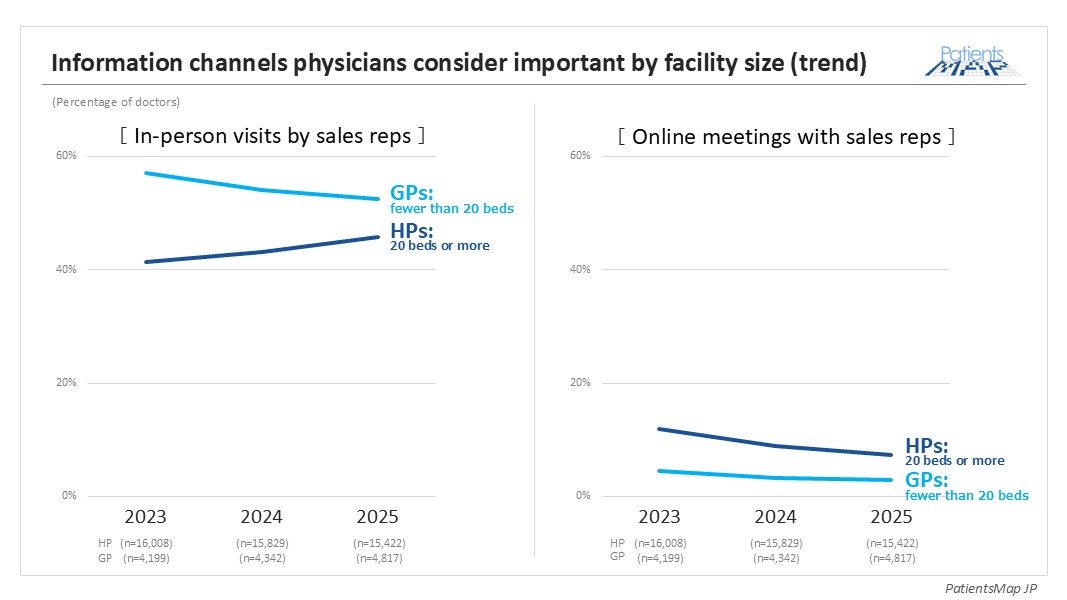
Next, we examine trends by facility size (HPs: 20 beds or more; GPs: fewer than 20 beds).
Discussion:
The importance placed on in‑person sales rep visits shows contrasting patterns between HP and GP physicians, indicating the need for clearly differentiated channel strategies.
HP physicians (return to face‑to‑face):
Among HP physicians, the importance of in‑person sales rep visits is trending upward, indicating a clear return to face‑to‑face interaction. In settings with complex internal decision‑making and prescriptions of highly specialized drugs, the irreplaceable value of high‑quality dialogue and tailored support appears to be driving this trend.
GP physicians (efficiency‑oriented):
Among GP physicians, the importance of in‑person sales rep visits, while still relatively high, has been gradually declining year by year. This seems to reflect not so much a move away from sales reps as a growing demand for efficiency—physicians seeking to obtain information in the gaps between consultations. For GP physicians, strategies that optimize human resources while increasing digital reach are likely to be a key source of medium‑ to long‑term competitive advantage.
In addition, the importance of online meetings with sales reps is declining regardless of facility size, indicating that they are losing their position as a primary information source.
Analysis Result 3: By Years of Experience:
Early‑Career Physicians Value In‑Person Interaction
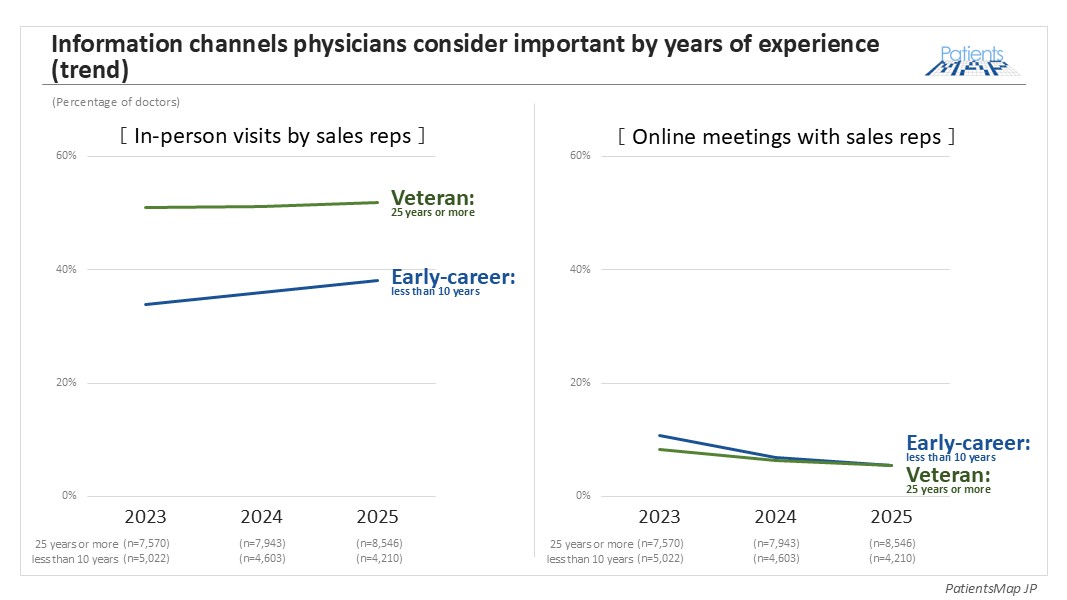
Lastly, we examine trends by years of experience (early-career: less than 10 years; Veteran: 25 years or more).
Discussion:
The importance placed on in‑person sales rep visits remains consistently high among veteran physicians, whereas among early‑career physicians there is a clear upward trend.
Precisely because younger generations can obtain basic information online, they may be beginning to reassess the value of sales reps who can address case‑specific clinical questions and provide tacit knowledge that cannot be obtained on the web. When engaging early‑career physicians, relying solely on digital approaches may be insufficient. High‑quality interactions with sales reps that offer tailored, case‑based solutions are emerging as a powerful differentiator.
Conclusion
Discussion:
This analysis, based on time‑series data from PatientsMap with responses from over 20,000 physicians, explored key principles of channel strategy in a hybrid landscape where digital and in‑person engagement coexist. The data reveal that physicians' information‑gathering behavior does not reflect a uniform "return to face‑to‑face," but rather a structural shift shaped by physician attributes.
- Overall, the trend points toward hybridization—digital channels for learning, in‑person channels for trust‑building.
- By facility size, polarization is emerging between a return to face‑to‑face among HPs and efficiency‑driven digital shifts among GPs.
- By generation, it is early-career physicians in particular who are increasingly seeking the added value of in‑person engagement.
These are market blind spots that a one‑size‑fits‑all strategy fails to address. Instead of pursuing uniform digitalization for all physicians or uniformly increasing field visits, the key to maximizing return on investment is to carefully optimize the mix of in‑person and digital channels based on the characteristics of target physicians.
Through further analysis of PatientsMap data, the following detailed analyses can be conducted:
- As GP physicians become less reliant on in‑person visits by sales reps, which alternative information sources are they beginning to place greater importance on?
- How do early‑career and veteran physicians differ in their use of digital channels other than sales reps?
- How do physician profiles differ between "in‑person‑preferring" and "digital‑preferring" groups?
What are physicians in your disease areas and target segments looking for today?
To close the gap between gut feeling and data and to build evidence‑based strategies, we encourage you to use PatientsMap actively.
More detailed analyses and tailored proposals can also be provided to address your specific needs.